



-
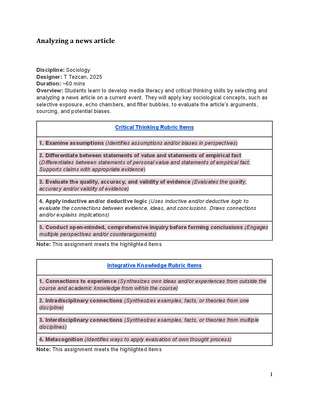
Analyzing a News Article
Tolga Tezcan
Students will synthesize academic knowledge (sociological concepts) with experiences (their own news browsing habits and selection). To differentiate between statements of value and statements of empirical fact within a journalistic piece. To engage in self-reflection regarding one’s own vulnerability to media bias and selective exposure.
-
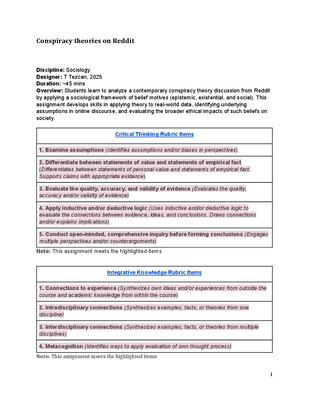
Conspiracy Theories on Reddit
Tolga Tezcan
To develop skills in applying sociological theory (epistemic, existential, and social motives) to real-world, user-generated data. To examine underlying assumptions and biases in online discourse. To evaluate the broader ethical implications of conspiracy beliefs on society.
-
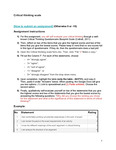
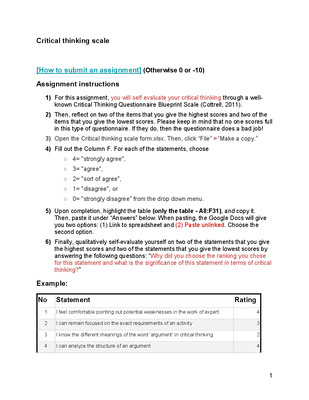
Critical Thinking Scale
Tolga Tezcan
To enable students to engage in metacognitive self-assessment by evaluating their own thought process using a critical thinking scale. To identify and reflect upon personal strengths and weaknesses in critical thinking skills.
-
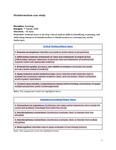
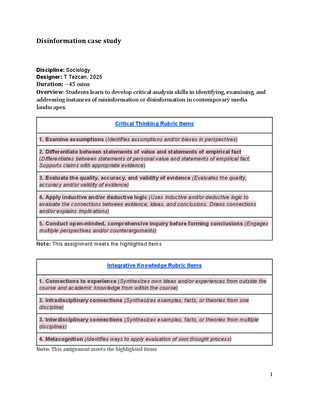
Disinformation Case Study
Tolga Tezcan
To examine the assumptions, intent, and motivations behind the creation and spread of disinformation. To apply sociological and psychological factors to explain the virality and acceptance of false information.
-
Use of Supporting Materials
Sunita Lanka
To identify a variety of reliable sources to support / strengthen claims and research, to understand how supporting materials lead to reasonable inferences and provide authentic strength to a claim (analysis), and finally to learn accurate citations.
-
Reverse Research
Robin de la Llata Aimé
Students are introduced to academic research and writing with a focus on methods of attribution.
-
Literature Review
Amanda Pullum
Students should learn to develop a social scientific research question; distinguish scholarly from non-scholarly sources; locate and evaluate relevant scholarly literature; and synthesize multiple scholarly sources.
-

Spanish for Heritage Speakers: Instructional Module #2
Gabriela C. Zapata
This is the second instructional module for the teaching of Spanish to heritage speakers at the intermediate level. The outcomes for this module are as follows:
1. Students will be able to understand the way in which a persuasive essay is organized and written;
2. Students will be able to continue applying the rules for the accentuation of palabras esdrújulas and agudas to improve their spelling;
3. Students will be able to understand the rules that govern the present tense in Spanish and why it is the most appropriate tense when writing a persuasive essay.
4. Students will learn the rules that govern the accentuation patterns for palabras llanas and hiatos, and they will apply these rules under instructor and peer guidance;
5. Students will apply the concepts learned to the development of a persuasive essay;
6. Students will apply the concepts learned to create and carry out an interview with a person of Hispanic origin in order to collect information about his/her work experiences in the United States.
Printing is not supported at the primary Gallery Thumbnail page. Please first navigate to a specific Image before printing.