


-
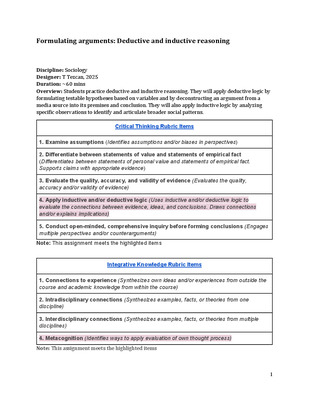
Formulating Arguments: Deductive and Inductive Reasoning
Tolga Tezcan
To help students practice deductive logic by formulating testable hypotheses and deconstructing arguments. To enable students to apply inductive logic by analyzing specific observations to identify and articulate broader social patterns.
-
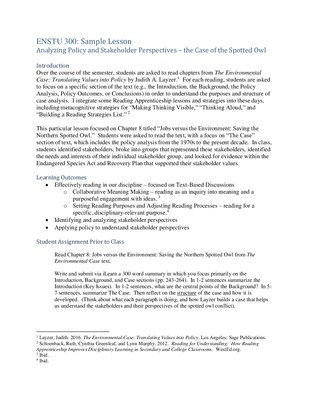
Analyzing Policy and Stakeholder Perspectives – the Case of the Spotted Owl
Victoria Derr
- Effectively reading in our discipline – focused on Text-Based Discussions
- Identifying and analyzing stakeholder perspectives
- Applying policy to understand stakeholder perspectives
[1] Schoenback, Ruth, Cynthia Greenleaf, and Lynn Murphy. 2012. Reading for Understanding: How Reading Apprenticeship Improves Disciplinary Learning in Secondary and College Classrooms. WestEd.org.
[2] Ibid.
-
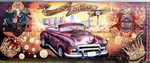
Spanish for Heritage Speakers: Instructional Module #3
Gabriela C. Zapata
This is the third instructional module for the teaching of Spanish to heritage speakers at the intermediate level. The outcomes for this module are as follows:
1. Students will be able to understand the way in which a descriptive essay is organized and written;
2. Students will be able to continue applying the rules for the accentuation of palabras esdrújulas and agudas to improve their spelling;
3. Students will be able to understand the rules that govern the use of adjectives in Spanish, including the exceptions that break these rules;
4. Students will review the rules that govern the accentuation patterns for palabras llanas and hiatos, and they will apply these rules under instructor and peer guidance;
5. Students will apply the concepts learned to the development of a descriptive essay;
6. Students will apply the concepts learned to create a presentation on a cultural aspect related to their family Hispanic heritage;
7. Students will learn how to prepare an academic presentation, and they will implement this knowledge in the oral presentation of their work.
Printing is not supported at the primary Gallery Thumbnail page. Please first navigate to a specific Image before printing.